
The Problem
Commercial waste collection has run on fixed collection schedules for decades. Unnecessary pickup are prolific. They consume fuel, driver time, and vehicle capacity that could have served another customer.
I set out to build a cellular device that measured dumpster fill level, detected service events, and then automatically generated optimal waste collection routes that serviced only the customers which truly needed it. The project was accepted into Columbia University’s CS3 Smart Cities Accelerator and eventually secured two letters of intent from New Jersey waste-management companies interested in deploying the technology.
Turning Customer Discovery Into Technical Requirements
My early concept looked straightforward: mount a distance sensor above the waste, calculate the remaining headspace, and transmit the result.
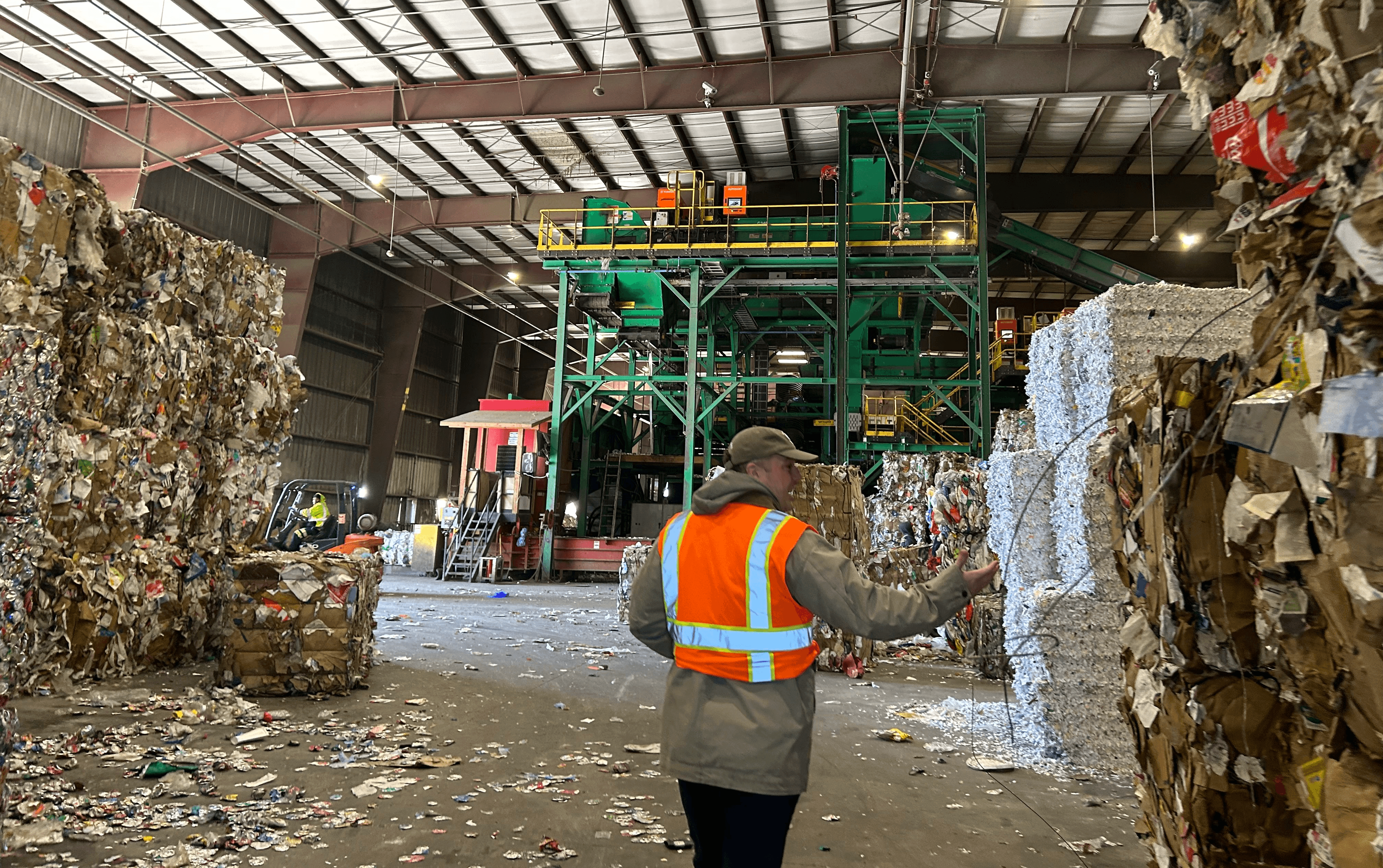
Then I toured Mazza Recycling Service’s collection and processing operation.
Mazza is not simply a landfill. Waste arrives to be collected, sorted, processed, and diverted into streams such as mulch and recyclable material before final disposal. Seeing that operation revealed constraints that I never would've found in the lab.
Dumpster interiors accumulate dust, grease, moisture, and standing liquid. Waste does not form a level surface; bags pile against walls, bridge across gaps, and arrive from unpredictable angles. Each loading event can introduce shock, abrasion, or a direct impact on anything mounted inside the container.
The visit transformed “make it rugged” into specific engineering requirements:
Avoid an exposed optical lens that could be obscured by residue.
Minimize protrusion into the loading path.
Eliminate horizontal surfaces where bags could accumulate.
Protect every enclosure penetration from water and debris.
Make installation and servicing possible without specialized tools.
Distinguish a genuinely full container from a temporary bad reading.
The field visit also exposed a second need. Fill level alone could not prove that a scheduled pickup had occurred. The device needed to observe both container state and service activity. Generated proof-of-service for waste management companies turned out to be a major value-add, as this allows for automated billing and less customer disputes.
Choosing the Sensors
The central challenge was not finding a sensor capable of measuring distance in a laboratory. It was finding one that could survive years of abuse in a dumpster.
Sensor | What I learned | Decision |
|---|
HC-SR04 ultrasonic | Inexpensive and useful for validating the ranging concept with an Arduino, but not protected for outdoor deployment. | Used for early bench testing. |
A02YYUW ultrasonic | Weather-resistant sensing face and UART output made it a practical step toward a deployable prototype. | Evaluated during prototyping. |
TFmini-S LiDAR | Its narrow optical beam reduced wall reflections, but an exposed lens introduced contamination and sealing risks. | Rejected for this environment. |
MB7137 I2CXL TrashSonar-WR | Designed for waste-container monitoring, environmentally protected, and capable of returning processed distance measurements over I²C. | Selected for the final architecture. |
Ultrasonic sensing was the best environmental tradeoff. It does not depend on ambient light and is generally more tolerant of airborne dust than an optical sensor. It is not immune to bad data, however. Condensation, soft materials, angled surfaces, wall echoes, and irregular waste geometry can all affect the return.
That distinction shaped the system: sensor selection reduced the environmental risk; calibration and signal processing handled the uncertainty that remained.
Converting Noise Into a Useful Decision
A single ultrasonic reading is not a trustworthy estimate of dumpster fill.
I first calibrated each installation by recording the distance from the mounted sensor to the empty container floor. The device then collected repeated readings rather than acting on one measurement.
The processing pipeline:
Rejects invalid readings and values outside the container’s physical range.
Applies a median filter to suppress isolated spikes.
Removes statistical outliers before estimating the current waste height.
Converts the filtered distance into a fill percentage using the calibrated empty depth.
Applies hysteresis near routing thresholds so a container does not repeatedly switch between “service” and “do not service” because of small fluctuations.
Ultimately, my final architecture was as follows:
Sensor to microcontroller: I²C. Two wires, addressable, and the sensor does its own signal processing — it reports a distance in centimeters rather than a raw echo waveform I’d have to time and interpret myself. That moves the hard part of ultrasonic ranging into a purpose-built part instead of my firmware. Fewer wires also means fewer sealed penetrations through the enclosure wall, which matters more than it sounds like when the enclosure has to be watertight.
Device to cloud: cellular, via a Particle Boron. WiFi was never an option — dumpsters sit in alleys and loading docks with no network. LoRaWAN would be more power-efficient but requires gateway infrastructure I’d have to deploy and maintain per site. Cellular works the moment you put the device somewhere, which is the right tradeoff when your unit economics depend on installation taking five minutes.
Data cadence is a power decision, not a product one. Fill level changes slowly — hourly reporting captures everything operationally useful, and the radio sleeps between transmissions. Sampling faster would drain the battery for data nobody would act on.
Designing for the Dumpster
The sensing device was built around a Particle Boron cellular microcontroller.
Local sensors communicated through I²C, UART, and 1-Wire. The Boron processed the measurements and transmitted device health, fill level, and service-event data over LTE-M.
The complete pipeline was:
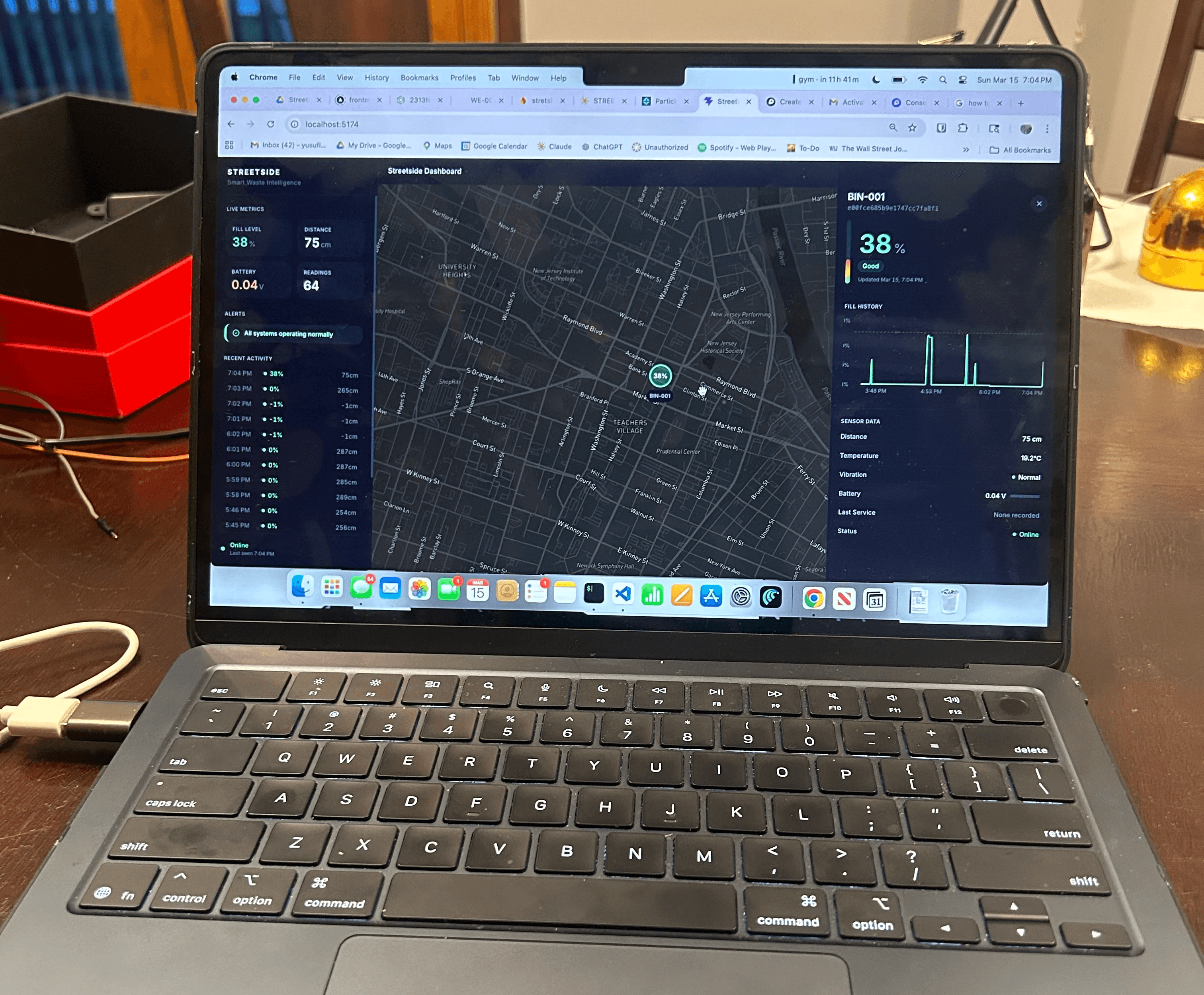
Ultrasonic and motion sensors → Particle Boron → LTE-M → Particle webhook → Firebase → React dashboard → OR-Tools route optimizer
Cellular connectivity was a practical deployment decision. Wi-Fi could not be assumed in alleys, parking lots, or loading docks. LoRaWAN could reduce radio power, but it would require the customer or installer to maintain gateway infrastructure. LTE-M allowed a device to begin communicating wherever cellular coverage was available.
The system transmitted approximately every three hours because dumpster fill changes slowly. More frequent uploads would consume additional battery and cellular data without materially improving dispatch decisions. The reporting interval therefore came from the physical process and power budget—not from a desire to collect the largest possible dataset.
The React dashboard gave operators a single view of container status, while an OR-Tools vehicle-routing model converted those measurements into recommended service routes. This connected the sensor to the actual operational decision: which containers should the truck visit today?
Rugged Mechanical Design
My first enclosure direction relied on an off-the-shelf sealed junction box. It addressed water and dust ingress, but not the geometry of the environment.
A rectangular box created a flat ledge inside the dumpster. Bags could land on it, catch against it, or bury the sensing face. The enclosure could remain perfectly dry and still fail at its actual job.
I replaced it with a custom, low-profile wedge enclosure designed in SolidWorks. Its angled upper surface encouraged waste to slide away instead of accumulating, while the reduced profile limited how far the device extended into the loading volume. The sensor angle was constrained by two competing needs: look toward the center of the waste surface while avoiding container-wall echoes.
Across four FDM revisions, I refined:
Sensor alignment and field of view
Internal packaging and wire routing
Lid fit and O-ring groove tolerances
Gasket compression around the sensor port
Fastener placement and assembly access
The geometry of the rim-mounted interface
This was an important lesson in mechanical design: ruggedness is not a single material property or certification. It is the result of geometry, interfaces, assembly quality, and the specific ways the product can fail.


Designing for Maintainability
Waterproofing a printed enclosure required treating every interface as a possible leak path.
The lid sealed against an O-ring groove designed around achievable FDM tolerances rather than ideal CAD dimensions. The sensor used a compressed gasket so its sensing face could remain exposed while the electronics stayed protected. Heat-set brass inserts replaced screws threaded directly into plastic.
The inserts served more than a cosmetic purpose. A gasket requires consistent clamping force. Screws repeatedly driven into printed plastic eventually loosen or strip, changing the compression on the seal after each service cycle. Metal inserts created a repeatable assembly that could be opened without steadily degrading the enclosure.
I also used sufficient wall thickness and print perimeters to reduce porosity along FDM layer lines. A sealed lid is not useful if water can migrate through poorly fused enclosure walls.

Winding The Project Down
Cold calls, facility visits, and persistent market research led to two signed letters of intent from New Jersey waste-management companies willing to evaluate StreetSide in their containers. That validated interest in the problem and gave me a path toward field deployment.
It did not yet validate a scalable business.
In the customer segments I explored, the issue was that the organization paying to install the sensor wasn't capturing the greatest savings. A property owner benefited from avoiding unnecessary service charges through lower service fees, but this reduced the waste collector's average revenue per customer. Fill-level visibility created operational value, but the incentives were not consistent from day one of the purchase. I believed that a fleet of StreetSide sensors would significantly improve the profit margin per-customer, but this could only be proven in a large-scale deployment, which ultimately wasn't a feasible achievement.
Ultimately, this project made me fall in love with mechatronics, to which I am deeply grateful for. This same passion, though, drew me into robotics projects with more ambitious visions.
StreetSide taught me how to evaluate sensors for a hostile environment, design and seal serviceable FDM hardware, build an embedded-to-cloud data pipeline, and turn noisy physical measurements into operational decisions. The most important lesson was broader: a technically sound system is not automatically a valuable product. Engineering begins with the underlying physics, but it succeeds only when manufacturability, data quality, field behavior, and customer incentives all align.